Proverbs 1:32 “For simpletons turn away from me—to death. Fools are destroyed by their own complacency.”
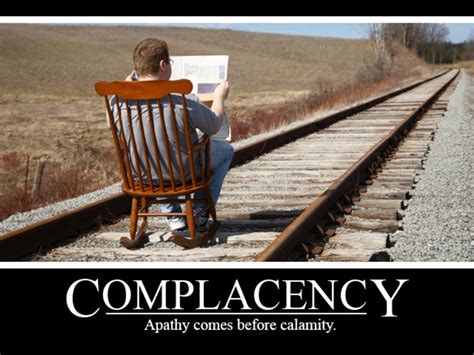 Last week I talked a bit about apathy, but today I would like to talk a little bit about its not too distant cousin, complacency. Apathy is being disengaged with the surrounding world and circumstances whereas complacency is being satisfied with less than the surrounding world and circumstances have to offer.
Complacency is settling for less than what we should because we have a false sense of contentment. It makes us sit back on our hands instead of forging ahead in our spiritual lives. Unfortunately, complacency is the disease that everyone denies having. As we all know, however, the first step in getting well is admitting we have a problem.
Complacent Christians have the idea that they have arrived.  In America this is an especially easy state of mind to fall into. We have it pretty easy compared to the rest of the world. Why should we get callouses on our knees praying when we have almost all we want and more. Unfortunately, when we lack any feeling of need or desperation, we get sloppy in our worship.
Barna Research reports that since the nineties, Americans have become more spiritually complacent. 40% of born again Christians do not attend church or read the Bible in a  typical week, 30% are not “absolutely committed to the Christian faith” and 70% are not involved in a small group that meets for spiritual purposes. The percentage of adults who can be classified as “born again” rose from 35% from the early 90s to 41% in the early 2000s. However, participation in 4 key behaviors declined and have continued to decline in this century; Bible reading (down from 45% to 37%); church attendance (from 49% to 42%); volunteering at church (from 27% to 20%); and adult Sunday school attendance (from 23% to 19%). The recent Covid scare has not helped matters. It is predicted that many of the people who have gotten in the habit of not attending due to Covid will not attend after Covid.
There is a story of a tool company that manufactured drill bits.  Faced with financial losses, company executives gathered to discuss the problem: a declining demand for drill bits. The CEO challenged his men: “How can we revive the bit market?” After an embarrassing silence, one member of the team dispelled the fog: “Sir, the market isn’t for bits–its for holes!” This simple truth illustrates what the church needs to recognize. Complacent people feel fulfilled because they don’t feel needy. People are not in the market for spiritual activity because they don’t see a need for spiritual activity. When someone needs to
  drill a hole he will think about buying a drill bit and when someone needs to fill a hole in his life he will look for a place to fill it. In this time the church needs to be that place for unbelievers and believers alike.
There is the story of three demons who were exchanging ideas to bring about the downfall of man. The first said, “Let’s tell them there is no God.” The second said, “Let’s tell them there is no Hell.” The third said, “Let’s tell them that there is no hurry.” It seems to me that they settled on the third suggestion.
Revelation warns us about this complacency in the future. “I know your deeds, that you are neither cold nor hot; I wish that you were cold or hot. So because you are lukewarm, and neither hot nor cold, I will spit you out of My mouth. Because you say, ‘I am rich, and have become wealthy, and have need of nothing,’ and you do not know that you are wretched and miserable and poor and blind and naked,” (Revelation 3:15-17) Is that the future or has the future arrived? God warns us of being lukewarm because it is more dangerous than being hot or cold. It has just enough heat to make us believe that we are okay. That kind of deception is a favorite ploy of Satan and many in the church seem to be falling for it.
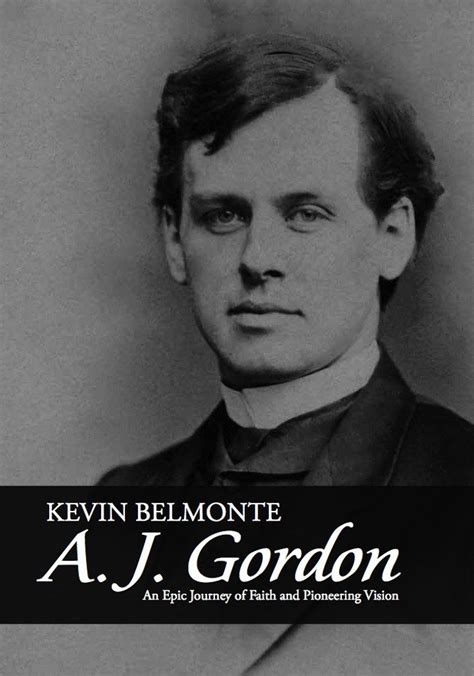 There is a great story about the famous, fiery English pastor, A.J. Gordon, who became the pastor at a large, well-established, but cold Boston church. After just a few weeks many of the senior members of the congregation moved to oust him because of his bold condemnation of the lifelessness of the church. After about a month, right before the axe was about to fall he gave a sermon called “The funeral of the Church.” It was a no-holds-barred, tell-it-the-way-it-is, God’s-Word-is-His-Word sermon. The theme was that the church was a casket and like a casket there was no room for converts because coffins are built for only the dead. He warned them of impending disaster if they did not repent. It was an hour of truth. Toward the end of the sermon the doors in the back of the church swung open and six solemn-faced pall bearers carried a casket up to the front. Pastor Gordon lifted the lid and challenged the congregation to file past the coffin to view the deceased on the way out. In the coffin, you guessed it, a giant mirror.
It seems to me that too many of us today need to look in the mirror to see if our  complacency is leading unto death. Paul tells us, “Test yourselves to see if you are in the faith; examine yourselves! Or do you not recognize this about yourselves, that Jesus Christ is in you–unless indeed you fail the test?” (2 Corinthians 13:5) It is hard to change others, but we can start with ourselves. Have we become “fat and sassy” in our christian lives? Are we going through the motions because that is all it takes anymore? Do we put more time into the needless and neglect the needful? We need to be cautious so that we don’t fall into the trap that Paul warns us of in Corinthians, “Therefore let him who thinks he stands take heed that he does not fall.” (1 Corinthians 10:1)
 So it is time for the church put on its big-boy pants. It is hard to put pants on someone else, so we should worry about our own legs first, but we shouldn’t be shy about pointing out lack of fervor in the Body of Christ. It is time to take our spiritual lives seriously even if things are going so well that it seems we don’t need God. That is, of course, facetious. No matter how it seems, we need God. We should not be fooled. The demons have lied. There is a hurry and those around us could use our hurriedness on their behalf.