“Indeed, my plans are not like your plans, and my deeds are not like your deeds, for just as the sky is higher than the earth, so my deeds are superior to your deeds and my plans superior to your plans.” Isaiah 55:8,9
I like to think of myself as okay. Not great, but at least okay. I am probably 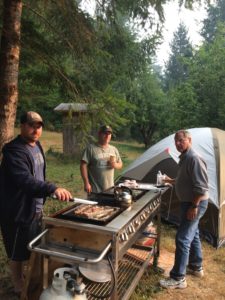 not the only one who likes to think that way (not about me, but about themselves!). It is comforting, I guess, to look around and believe that there are a lot of people worse than we are. But today I was looking at these verses in Isaiah and I realize that the word “your” in these verses was talking about me. Not the other guy, but me. My deeds are not like God’s deeds. My ways are not God’s ways. In all ways, His ways are superior to my ways.
This reality can be fairly depressing if we ponder it. We fall short in all ways. Not just some of us, but all of us! Well, it would be depressing if the story stopped there. But God does not stop there and leave us with no hope. Almost every part of the Bible is about hope. It tells us how we can triumph in spite of our misguided ways. The Bible gives us hope in a world of hopelessness. Psalm 46:1 says that “God is our refuge and strength, an ever-present help in trouble,” which is so much more comforting than “I am my own refuge and strength and I can rely on myself in times of trouble.” Since my ways are not God’s ways, to rely on myself is a losing proposition.
A few years backI took back a couple of inferior rafts that I had bought for camping. I upgraded to one (not two cheap ones, but one good one) that actually floats. I thought it would be a good investment, especially for whoever is in the middle of the river in it. (Never go cheap on eye surgeons or rafts.) Our ways are like those rafts. They are inferior and regardless of how fast or slow the leak is, our ways will eventually “leak.” Like the rafts, we cannot patch them on our own. We can try to fix things up, but it will never work. I had to get a new raft, just like we have to become new creatures. We can’t patch up the  old, we must become new. That can only be done through Christ.
I like to think some of my ways are good. But no matter how good I think they are, if they are mine, they fall short of the perfect ways of God. What I need to do is to know God well enough to know His ways. When I start becoming more like Him, my ways will start to come in line with His ways. Some of us will go through life trying to patch one thing up after another. We leave God sitting over to the side, waiting for us, while we patch hole after hole, only to have the next one spring up. When we do that, we are just kicking the can down the road. The fix will be temporary. The only permanent fix is to give ourselves over to Christ and allow Him to make things new. By the time some of us are old we are floating in a pathetic raft barely staying afloat made up of more patches than original raft. We paddle around wondering why we are so stressed, while a brand new one with our name awaits just in reach.
Many people want to try to do their own thing and try to align God with them. That would be like coming back to camp and instead of pulling ourselves to shore, we try to pull the shore to us. The shore, like God, is fixed. We must be the ones that move. If God’s ways are superior to ours, why should He come to us. It is logical that we go to Him. Unfortunately, the common practice is for us to do our own thing and then try to say that is  God’s way as well.
On one of our camping trips with the kids and grandkids I was out in the river and my raft started sinking. I realized that I was probably going to go down with both ends of the raft above my head closing like a giant clam. Between screams for help, I thought how much better it would have been to have a raft that holds air. Now I have one because I purchased one. The good news is that if we want to get rid of our inferior ways, we don’t have to make a purchase. Our new ways have been paid for in full, and all we need to do is to receive them. Paul’s prayer for the Ephesians was the same prayer we should pray for ourselves. “(I) am asking God, the glorious Father of our Lord Jesus Christ, to give (me) spiritual wisdom and insight so that (I) might grow in (my) knowledge of (Him). (I) pray that (my) heart will be flooded with light so that (I) can understand the confident hope He has given to those He has called—His holy people who are His rich and glorious inheritance.” Now that’s how you fix a leaky raft.



 say that the 20th century was the most peaceful century in history. I guess he was sleeping in history 101 when they covered WWI, WWII, the Korean War, the Vietnam War, and the other 27 Major conflicts of the 1900’s. Historian Eric Hobsbawn said in his book on the 1900’s, “the 20th century was the most murderous in recorded history. The total number of deaths caused by or associated with its wars has been estimated at 187 million, the equivalent of more than 10 per cent of the world’s population in 1913.” He went on to say that the century experienced very few periods of worldwide peace. It seems to me that the twentieth century isn’t the best time period to reference while extolling the peaceful progress of humanity.
 than any atheistic philosophy I have ever read. The idea that this world, life, and culture are evolving for the better in any way is a pipe dream. Peace on this earth can only be found in one place, and that is in the Lord Jesus Christ. All other peace is fragile, fleeting, and in the long run, fake. In Jeremiah 17:9 we are told, “The heart is more deceitful than all else And is desperately sick; Who can understand it?” Later in Matthew 15:19 we see that man has a heart problem, “For out of the heart come evil thoughts, murders, adulteries, fornications, thefts, false witness, slanders.” These comments on man seem to match what I see in the news a lot more than an atheistic view that we are building societies of peace and justice.
 Until all things become new through Christ, this world will not get better. The bottom line is this: We are created with a knowledge of right and wrong but without the power within ourselves to enforce it. We will continue to ignore what is right until we are filled with He Who is right. That is not evolution of our world, but revolution in our souls. We must go against our natural tendencies for evil and be filled with that which is good. Until then our world’s progression is nothing more than regression.
 times we try to resist him in passive ways, giving God the silent treatment as we refuse to pray, worship, or even talk about him. Another strategy we sometimes use for resisting God may be the worst of all. We pretend to be following God. We merely go through the motions, looking okay on the outside, fooling even the most keen observers and maybe even fooling ourselves.
 There is a story about a little boy who is told to stand in the corner by his mother. He defiantly sits in the corner. He is mother tells him to stand up. He stands, but yells back over his shoulder, “I may be standing on the outside, but I’m sitting on the inside.” When we look like we are taking a stand for God, but are actually “sitting on the inside,” we can’t fool anyone for long. Eventually the charade will catch up with us. Sincerity of heart has always and will always be how God views our actions. When our kids were kids (some of you remember), we didn’t like it if a task was assigned and they rolled their eyes. Rolling the eyes is a show of dissatisfaction with the task at hand. Too often we roll our eyes at God when doing work for Him.
 If we sing in worship or participate in a Bible study, but our participation is a pretense having to do with what we should do rather than what we want to do we will eventually be found out- usually under fire. We have counterfeited honoring God and it will not stand true scrutiny.
 God does not make us servants of God. Being a servant of God does. One of the scary aspects of “religion” is that we can easily “fake it.” But we are not in a religion, but a relationship. That is harder to fake.
 If I came up to you and said I had a gift for you and then gave you a price you would have to pay for it, it would no longer be a gift. The covenant that God has made with us is kept on the strength of who He is, not on what we can pay. We can never pay enough. The price is too high. As hard as that is to understand, we need to get a hold of that if we are going to experience grace.