"God is our refuge and strength, a very present help in times of trouble." Psalm 46:1

Author: Rick (Page 17 of 36)

“Stay the Course, Even When Others Don’t”

“Do you not know that all the runners in a stadium compete, but only one receives the prize? So run to win. Each competitor must exercise self-control in everything. They do it to receive a perishable crown, but we an imperishable one. So I do not run uncertainly or box like one who hits only air. Instead I subdue my body and make it my slave, so that after preaching to others I myself will not be disqualified.” 1 Corinthians 9:24-27

In these verses Paul compares the Christian with an athlete in competition. He talks about our discipline, our effort, and our integrity. These are good verses for us to keep in mind because today our opponents are many. Besides battling against our own flesh and the principalities and powers, we battle against a world that has turned upside down and is changing the rules of morality to suit a disintegrating society.

Christianity is a faith of common sense. As we stray further and further from Christian principles we also leave common sense further and further behind. I find it amazing that groups that will close entire sections of a forest down for the tiniest of creatures can support the continual killing of the tiniest of humans. Unfortunately, most Christian principles are recognized by everyone as just Christian principles. Some are so against Christianity that they must oppose everything about Christianity to prove their dismissal of the faith. Consequently, they must reject many of the common sense principles that Christianity brings to this world. Much of the world is going along with this craziness, but every day you will hear people saying, “where is people’s common sense?” Sadly, it is disintegrating by the same proportions that people reject the Biblical world perspective.

I read a story about an unusual happening in the 1990’s in an NCAA Division II national championship cross-country race in California. A runner named Mike Delvaco and 127 of the state’s best runners were competing on a 10,000 meter course to see “who would win the prize.” About three miles into the race, Delvaco was somewhere in the middle of the pack, when he realized that the runners had made a wrong turn. So he yelled out, “You’re going the wrong way,” but they didn’t listen. Only 4 others followed Mike when he turned in the right direction…and suddenly, he found himself in the lead. He must have had some doubt when the field dropped from 128 to 5, but he stayed on course.

However, that lasted only about a mile. Mike and the runners who followed him were soon reunited with the larger pack who, having gone the wrong way, actually shaved about a half a mile off the course. The shortcut of the many put them ahead of the small band of runners that took the correct path. This was bad enough for Mike, but the final blow came when, because so many of the runners had gone the wrong way, the officials changed the official course route to accommodate their error. So when Mike Delcavo finally crossed the finish line, he was number 103 overall. His right action, as well of that of four others, was ignored and because so many went the wrong way they were rewarded with a shorter race. At the end of the race, one of Delcavo’s competitors “thought it was funny that he went the right way.”

Isn’t that a telling statement? In our mixed up world, when so many are wrong, wrong becomes right. Instead of the world keeping a standard of acceptable behavior, it changes what acceptable behavior is. But although the world changes “the course” to accommodate itself, God does not. He knows the course; He made the course; and He expects us to run the course as marked. Numbers do not influence God. No matter how many go astray, he does not accept the majority as a sign of rightness. In Noah’s day God did not change his plan for the sake of the majority.

When I was in junior high I had a math teacher named Mrs. Woodward. She was a stickler for the right answer. No matter how many kids missed a question or no matter how many different answers they had, she would only accept the right one. Unbelievable! But would she have helped us as students by accepting less than the truth?  Maybe it would have helped our grade for that semester, but it would have cost us in the long run.  Mrs. Woodward refused to enable our future failure by accepting wrong as right.

 In our day and age the majority seems to dictate the rightness or wrongness of an issue. In some cases, that might be fine (speed limits, taxes and fees, etc.), but in moral issues the majority can’t be the determining factor. In Jeremiah 17:9 God tells us, “The heart is more deceitful than anything else, and incurable–who can understand it?” Do we really want a majority deciding the moral direction of the country? Yes, if the majority uses the Word of God as a moral compass. No, if the only compass they have is a deceitful heart.

Contrary to what many believe in this day and age, there is right and wrong. Relativism is a dead end street. Without any standards to make decisions we are at the whims of the loudest, biggest, or meanest. Much of the world uses similar standards of measurements for distance, weight, and volume. That is so everyone can understand each other. If there were hundreds of different measurements for lengths, every distance would have to be renamed hundreds of times. No one would be able to determine if a mile was actually a mile. In some countries, a mile might not exist as a measurement and they would have to invent a new word for that distance. It would be very cumbersome.

Only a few people at New Hope (my church) know this (because I mentioned it in a sermon), but my height is also a measurement found in the dictionary and and on the internet. I am a smoot. One smoot is equal to Oliver Smoot’s height in 1962 which was 67 inches. Smoot was a student at MIT and as a fraternity prank they used his height to determine the length of the Harvard Bridge which stretches between Boston and Cambridge.  Smoot would lie down and his frat brothers would make a new mark each time he repositioned. The bridge’s length turned out to be 364 smoots plus or minus one ear. The markings on the bridge are redone each year by the fraternity and with the blessing of the city have been maintained through several bridge renovations. It has become quite a tourist attraction. So at 5’ 7” I am a smoot. (By the way, for the curious, the ark was about 81 smoots long, give or take an ear!)
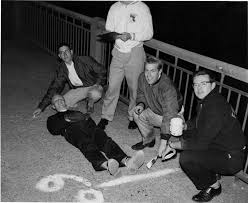
You can see what happens. The smoot has to be translated back into measurements with which we are familiar, or a smoot is meaningless. When we don’t have any standard of right or wrong and everyone just determines what it is on his own, and it is a chaotic situation. Actions that used to be considered “wrong” not only become acceptable, but become the only actions that are “right.” I did a chapel service at a Boy Scout Family Camp one weekend. I went through the scout oath, scout law, scout motto, etc. from the 1911 handbook. I compared the admonitions of the handbook to the admonitions of the Bible.

Needless to say, things have changed in our world.  When a phrases like, “physically strong, mentally awake, and morally straight” occur, they rely on accepted standards of physical strength, mental alertness, and morality. The definitions of those terms have been so obscured that what these phrases mean now is anybody’s guess. Of course, for those of us that believe that the Bible defines standards for behavior, we also interpret the handbook phrases the same way.  We take them for what they meant in 1911 when God played an important part of the Scouting experience. Those who do not hold a Biblical standard look at a term like “morally straight” and must determine what it means on their own.  To some “morally straight” might mean being straight with themselves and doing whatever they want.  Is that what it originally meant in the scout handbook (or in the Bible)?  Probably not.

Like Mike Delvaco showed us, taking the right path does not always “pay off” with reward. It takes courage and conviction to follow wholeheartedly after God instead of the rest of the world. Sometimes it can get lonely running alone, and we may be wondering where the others are going. We might even yell out, “You’re going the wrong way,” but most won’t listen. Instead, we will be heckled and ridiculed by others who pursue their own course. And ultimately, the “race officials” may reward others for bad turns. The news consistently show us that! But we must remain on God’s course. We must run with discipline, doing our best, staying on course, and when the race is over and when we have finished the course, He who is the true judge will say to us, “Well done, good and faithful servant!”

Living out the Gospel

“And all believed and were of one heart and mind, and no one felt that what he owned was his own; everyone was sharing.”   Acts 4:32

In this verse Luke gives us a picture of the early Christian church, and he reveals the source of its power to impact the world around it. Remember, the early Christians were IMG_1678not superhuman. They were human; they were frail; they were sinners; and just like us they needed God’s grace and power- especially if they were going to keep the gospel alive at a time of small numbers and great persecution.

It seems that the church finds its greatest growth in times of persecution.  In some parts of the world today the church is growing at an unheard of rate.  Yet, in the western nations, the church is experiencing decline. Difficulty seems to breed a togetherness of purpose. In places where people must work together, they do work together.  In places where people can be individuals and survive, they work as individuals.

So, what were the keys to the ministry of the early church that changed the world forever? First, they are described as believers. Only those who have a common faith in Jesus Christ as Lord and Savior can enjoy the unity of spirit and purpose that was seen in the early church. Our power to live for God, rely on God, and commune with God depends on our belief in God. That does not mean that if we have a day of doubt we lose our relationship with Him, but it does mean that we need the indwelling Holy Spirit to have the faith necessary to grow in Him, and consequently, to grow the church.BibleLens_2019_08_19_08_52_36_3200

Secondly, because of their common faith in Jesus Christ, they were of one heart and soul; they were singular and focused in their objective. They knew the reason for their existence as a church was not to entertain or even to do good in the community. Their single intention was to exalt the name of Jesus Christ. They were unified, but not at the sake of truth. Today too many churches and Christians put unity above truth. They say we must get along at no matter what, but that cannot be. The early church put truth above unity and truth above tolerance. They would never have sacrificed truth for any temporary peace. They knew that unity gained at the cost of truth would only result in a false unity.

 Jesus did not skirt the truth in His ministry.  He would have gotten a D in most evangelism classes today.  He said that we must die to ourselves, must leave mother, father, brother, sister, must prepare to be persecuted.  He overturned cultural norms.  He did not embrace cultural abnormalities just for popularity sake. He did not just overturn the money changers tables, he overturned the long-held (fallacious) beliefs of the church, culture, and communities.  For all His efforts, He was killed.  He placed truth above all.  He presented the kingdom of God in its truest light, even at the detriment of popularity.

Finally,  using Christ as their model, the early believers endeavored to glorify Christ in their actions. This resulted in practical implications for their daily lives. Although they had personal possessions, they did not see these things as their own. They saw a need to freely give and saw all they had as gifts from God. They knew that part of the key of spreading the gospel was to live out the gospel. To present the gospel of the great Giver of peace, they needed to be givers themselves. Believing, unifying, and sharing were the prerequisites of presenting Christ to the world.BibleLens_2019_08_19_09_02_12_2360.jpg

Believing, unifying, and sharing are still prerequisites of presenting Christ to the world.  Without belief we will lack power, without power we will fail to work together, and without togetherness, our sharing will be more limited. The early believers modeled a growing church in the face of difficulties.  You notice that the first letters of our devotional words form the word BUS- believe, unify, and share. The early church rode that “bus” because if they hadn’t, the early church would not have moved.

We, too, are called into oneness with fellow believers to be examples to the world of Christ’s love. We are called to allow that “BUS” to move our churches forward. We should strive with fellow believers to exalt the name of Jesus by our actions. If we believe, it is because of Christ; if we live in unity, it is because of Christ; if we consider all we have as God’s, it is because of Christ. If we do these things, others will see us and want to know what is different about us. It is then that we can say to them, “It is not what is different about us, but who is different within us.” Step aboard and allow God’s Bus to take us where He wants us to go.

Show and Tell…

“To sum up, all of you be harmonious, sympathetic, brotherly, kindhearted, and humble in spirit…” 1 Peter 3:8

We are bombarded every day with negative news. There seems to be more violence and evil acts than ever before. It may seem like this is a new phenomenon, but this kind of behavior has existed ever since the fall. Cain killed his brother Able and it has been downhill ever since. But we are of a faith that calls not for violence, revenge and hate but one which calls for peace, forgiveness and love. That is a unique message among the people of today.IMG_1219

The New Testament and most notably the epistles of Paul were written for us today. In most of the Old Testament there were two kinds of people- the people of Israel and the gentiles (everyone else). In the Old Testament there were also countless stories about fighting among the people. There seems to be a painful story of violence scattered throughout every book. But though violence in the world has not ended, the message of the Bible for us today has become clear. Although there are still only two kinds of people in the world, those of the body of Christ and those who are not of the body of Christ, the life, death, burial, and resurrection of Christ has brought a new message of love into the world.

In today’s verse Peter calls us to get along with others, to be kind toward others, to be compassionate toward others. At the beginning of the verse he uses the phrase “to sum up” and this is a fair portrayal not only of his previous words, but the words of the whole New Testament. Throughout the New Testament we are instructed to care about one another. Whether the speaker is Jesus, Luke, James, Peter, or Paul, or one of the many others, the exhortation is one of love. I am convinced that if we who know Christ lived as the Word instructs, the need for missionaries would be eliminated. Everyone who came in contact with a Christian would want to know more about Christ, and anyone who knew Him would be able to share Him. Our love would be like a wildfire on a dry hill, spreading with every gust of wind that hits it.

I have wept in the night for the shortness of sight,
That to somebody’s need I was blind;
But I never have yet felt a twinge of regret,
For being a little too kind.

Today we will have countless opportunities to show the world who Christ is. It may be in small ways or big ways, it doesn’t matter. We may be the closest some people get to Jesus today. Our small kindness might be the last step in series of happenings in their journey to know Christ. The world is full of evil, but Christ calls us to be good, and the good that we can do should contrast so vividly with the world that people cannot but ask who this Jesus is we follow. Remember, we do not do kind deeds for just kind deed’s sake. We do kind things because it will give us the opportunity to share Jesus. Our kindness, though called for in the Word, will not, on its own, introduce others to Jesus. Our kindness should just be a vehicle that allows us to share where we receive our power to good.

So do good today. In this pretty dark world, it can sure use some light, and as we know, Jesus is the Light of the World.

Balancing Our Witness

It sometime seems like life swings from one extreme to another. Finding a balance in life is very difficult and finding a balance in the Christian life is even more difficult. That images-27.jpegreally seems to be the case when deciding which “method” is right when trying to spread the gospel. Some stand on the corner yelling accusations at passers-by (even though they don’t even know the person), while others know people for years without even mentioning the name of Jesus in all that time. We pick either an attack philosophy that runs people off or a “look-at-my-actions” approach that relies on others figuring out that Jesus is the reason for our good behavior. These kinds of extremes can be very problematic.

No one will enter heaven just by knowing a Christian. Others around us might like us, might even want to be like us, but if our faith is so reserved that they can only find out the part that Jesus plays in our lives by stripping away many layers of other “stuff” first, it is a gamble on our parts. The “gospel-living” method of spreading the gospel without the “gospel-giving” part is very dangerous.DCP_1276

Colossians 4:2-6 gives us some instruction on witnessing to others that we might keep in mind as we go through our day. In these verses Paul is telling the Colossians how to pray for him in his witness and consequently how we should pray for others and ourselves. He tells them to “continue steadfastly in prayer, being watchful in it with thanksgiving. At the same time, pray also for us, that God may open to us a door for the word, to declare the mystery of Christ, on account of which I am in prison— that I may make it clear, which is how I ought to speak.” Paul was not in prison because he just lived a life of Christ, but because he spoke of it as well. He asks the Colossians to ask God to open doors for the Word that he might share the mysteries of Christ. He also asks for prayer that he might make the the gospel of Christ clear. Notice he is speaking of verbalizing his faith. He is not only stating that he should speak, but how he should speak- giving a clear gospel to those who will listen.

Unknown-20.jpegA man came up to the famous evangelist D.L. Moody and criticized him for the way he went about winning souls. Moody listened courteously and then asked, “How would you do it?” The man, taken aback, mumbled that he didn’t do it. “Well,” said Moody, “I prefer the way I do it to the way you don’t do it.”

That was what Paul was saying to the Colossians (and thus us) when he said, “Walk in wisdom toward outsiders, making the best use of the time. Let your speech always be gracious, seasoned with salt, so that you may know how you ought to answer each person.” Notice here that graciousness is a key to giving the gospel. But notice also that Paul does not stop at gospel living, Unknown-18.jpegbut speaks of gospel giving. If we live sanctified lives that is a wonderful witness of the love of Christ, but if no one knows it is because of the love of Christ, it will not draw them to Him. Paul says to “walk in wisdom…making the best use of the time.” The best use of our time would be to do what Paul did- live a life according to God’s Word while at the same time sharing why we can live that life. That is the balance that is called for in the Word- that is the balance we should seek.

Have a wonderful day.

Be careful of the who, what, and where of our lives

He also said: “A man had two sons.  The younger of them said to his father, ‘Father, give me the share of the estate I have coming to me.’ So he distributed the assets to them.” (Luke 15:11-12)

Recently I did a sermon out of Luke and in preparation  I reread the story of the prodigal son in Luke 15. The more I read, the more I realized that there are a lot of truths packed into a small number of verses. In the past I usually concentrated on the actions of the Father,  but this time I noticed some harsh warnings through the actions of the son.

As we can see in verses 11 and 12, the youngest son was unsatisfied with his lifeimages and not willing to wait around for his father’s demise (I hope not all children are like that!), and he asks for his inheritance early. Surprisingly, his father grants his request and gives him his portion of the estate early. The son takes the cash and makes a dash for his new life of excitement. In doing so, he leaves us a playbook of destruction that if we follow will result in eventual pain and suffering.

The young son was unhappy with what he had in his normal life and was seeking more. He was much like all of us in different times of our lives. Benjamin Franklin said that, “Discontent makes rich men poor, and contentment makes poor men rich.” I think he had it right. UnknownWe often look at the lives of others and envy what they have. Constantly looking at what others have and comparing it to what we have is a dangerous venture. It can lead to pursuits that take us into the wrong places, to meet the wrong people, to experience the wrong pleasures. Often instead of hobnobbing with the princes we end up hog-slopping with the pigs.

“Not many days later, the younger son gathered together all he had and traveled to a distant country,” (Luke 15:13a)

We can notice here that to be involved in a new lifestyle, the son had to go to places where his new lifestyle was accepted. People who want to absent themselves from the things of God, must absent themselves from the places of God. Church is not a very good setting to run a gambling ring (ignoring the Baptist bingo rings here). Most people think it would stink to get skunk-drunk at a Bible study. Telling dirty jokes in a sermon seems a little too….well, dirty.

If we want to replace God in our lives, we must place ourselves in some pretty ungodly places. That is the first thing this young son did. He ran off to a place far away that would not remind him of the things he was avoiding. He took his money and ran to a non-threatening setting where he could be “himself,” surrounded by others who could be “themselves,” in an environment of nonrestricted behavior. It was a nirvana of guilt-free bliss…for awhile.

I read a story once about a person who took in a raccoon as a pet. Raccoons go through some radical physical changes at about two years old. During this time they can (and most of the time do) become very aggressive. The raccoon owner was repeatedly warned about the danger, but believed that her raccoon would be different and their relationship would overcome the natural tendencies of aggression.Unknown-1 The woman had to go through several surgeries after her pet attacked her and left deep lacerations in the her face and neck. We can develop a relationship with sin and believe that it will never turn on us, but it does. That is the natural way of sin. Sin is a slicked-up escort who comes dressed for an elegant ball and takes us the sewer sock hop instead.

To the delight of the Father, the son returned to the fold, but the older brother was not so delighted. These were the words of the unhappy older brother.

“But when this son of yours came, who has devoured your assets with prostitutes, you slaughtered the fattened calf for him.” (Luke 15:30)

Apparently they had some knowledge of the younger son’s behavior in his absence. We can see here that the younger brother had taken another important step in starting a new life without God. He had to replace the people in his life with those who would be complicit in his new lifestyle. We find out that he began running with riotous people and harlots. These people would be enablers more than advisors. They could not condemn his lifestyle without condemning their own. Years ago a psychology professor performed and experiment in his classroom. He would bring in ten students, nine of which were in on the ruse. They would look at three lines on the board of varying lengths. He asked the group to raise their hands when he pointed to the longest one. The nine students who were in on the ploy raised their hand when he pointed at the medium-length line. The “stooge” would look around and eventually raise his hand. images-2It happened time and time again, in fact, the unsuspecting “sucker” went along with the group 75% of the time. There is a saying that many people would rather “be president than be right.” In other words, it is easier to go along with the crowd than to examine the truth. If we surround ourselves with people who will reinforce what we want to believe, like the young boy did, we will not see the flaws in our thinking. We will go along with things that may be wrong and be happy about it.

The son in this story would probably say that he wanted to hang with people who were not judgmental (ever heard that before). He wanted to buddy with those who would not correct him or point out the danger in his decisions. The boy squandered all his money. Did his friends council him away from such. Probably not, because they may have even had a part of the action themselves. After all, maybe they could make up for some of the money they had already squandered. There is a commercial that says, “Friends don’t let friends drive drunk.” Is there an outcry against this commercial because it illustrates intolerance?  No, because it is right to warn people of danger and everyone knows it. Is it judgmental to stop people from doing something that is not good for them? I would think it would be evil not to stop them.

“where he squandered his estate in foolish living.” (Luke 15:13b)

Finally, the young boy had to change his pleasures if he was to truly adopt this new lifestyle to its fullest. He had to immerse himself in activities that left no reminders of his previous commitments. It is doubtful that his pleasures included worship any longer. Pleasures that conflicted with a godless lifestyle would have to be abandoned because he would not want throw a moral monkey wrench into his new and exciting life.images-3 When the son abandoned his family, he had to also abandon any activities that reminded him of the life that was. He had to take on new pleasures that would not give him any tinges of guilt. His pleasures had to help sustain his new life by not reminding him of the old.

Of course, sin only satisfies so long. Sin is like cotton candy. It looks substantial when you buy it. It can be a pink delight twice the size of someone’s head. But it is really just a small amount of sugar and coloring whipped up to look large. As soon as you take a bite, you realize that it melts into nothingness. It is not filling. Can you imagine how many cotton candies it would take to fill us up? More than any of us could afford, I am sure. Sin is that way. It looks satisfying, but will come up short in the long run.  It is like the modern bag of chips that is size of a pillow, but consists of air and six chips.  After all, Satan is a deceiver. He will not let us be “fulfilled” for too long. He is much like the fickle slot machine that will let a person win just enough to keep him coming back, but lose enough to keep the person broke.

The lesson of the prodigal is a warning for all of us. Most of the time, if we are running from God we will change the places we go, the people we see, and the pleasures we enjoy. If we see ourselves moving away from the things of God we should check our hearts. images-4Often our move away takes place slowly until there seems to be no turning back. Most of us will not change lifestyles in a moment’s time. The young son in Luke 15 did not change overnight. In his heart he started a move away from God, and his feet finally followed.

Satan won’t let the party last too long. After a little festive celebration, a person will look around and realize his life is a pigpen and the only thing on the menu is slop. It is inevitable. If we want to stay close to God, we need to surround ourselves with God things. We can run, but we can’t hide. He will be wherever we go, but we often try to overwhelm His presence with the things of the world. He stands in the field, checking the horizon, awaiting our return, so He can run to meet us. images-5We need to do our daily check to see if we are getting closer to or further from God. Where do we frequent? Who do we run with? What do we like to do? If God things play a minor part in these areas, we might want to check the previews of coming distractions. We might not like what we see.  Maybe then we will realize that we cannot use world-shaped pegs to fill a cross-shaped hole in our hearts.

Have a great day.

« Older posts Newer posts »

© 2026 HE HAS OUR BACKS

Theme by Anders NorenUp ↑