"God is our refuge and strength, a very present help in times of trouble." Psalm 46:1

Author: Rick (Page 30 of 37)

Be Real for God…

“Love the Lord your God with all your heart and with all your soul and with all your mind and with all your strength.”  (Mark 12:30)

Last week I referred to a Pew Poll that many took as the harbinger of secularism’s coming triumph over Christianity. I tried to explain why I thought reports of Christianity’s death were premature. Today I would like to explain in a little more depth (but not length) why I think that a wise bookie should not bet against Christianity, even weighing the present cultural shifts we are experiencing.

In passing in my last post I mentioned three groups of people who purport to be Christians on most surveys and polls. About a dozen years ago a large survey called ARIS (American Religious Identification Survey) used its statistics to predict the demise of Christianity.  It found that self-identifying Christians had dropped from 86% in 1990 to 76% in 2009.  During that same time period the “nones” (those declaring no religious affiliation) had risen from 8% to 15%. All kinds of magazine articles, blog sites, and news outlets ran headlines that expressed the need to call hospice for Believing America.  A Pew Poll a few years ago added fire to the flames, and the death knell has been ringing even louder.

If statistics alone were the measuring stick, Christians might be pulling out the life-support gear, but as with most statistics there are other facts beneath the numbers. What I think the numbers tell us is that people are just being more honest than they have in the past.  The choices on most surveys are pretty limited, very nondescript, and fairly black and white.  If the survey was set up to give more accurate definitions of terms, I don’t think we would see the “decline” of Christianity in the same way as most are seeing it now.  The fact is that most people who are no longer calling themselves Christians are not doing so because they have changed their minds about Christianity; it is because they are coming out of the closet with their true feelings about Christianity.

Last week I talked about three classifications of Christians.  Within those groups there are smaller classifications, and it is with these is mind that we should check the numbers.  Of course, these are broad categories and the numbers are not exact, but I think classifying different “types” of Christians is the only way to really evaluate the data we are seeing.  In a way, it is still disheartening, but in another sense, it is enlightening.

These categories- cultural, congregational, and convictional have always existed, but as culture loosens its reigns on what is acceptable morality, the numbers in these groups will be affected.  In descriptive terms they might be categorized like this: the poorly committed, the conveniently committed and the truly committed, but those are probably too broad of strokes to really build a strong argument on.

Cultural Christians are generally the “I live in America, so I must be a Christian group.” They have inherited their faith from others, but have never experienced it themselves.  They believe what others have told them, are possibly loosely affiliated with a church and might know its general location and would have marked the box Christian because they knew they were not Muslim.  These folks make up about 33% of self-professing Christians.

Congregational Christians are occasional church attenders, and might even have a church “home” of sorts. They are often called “Churchtains” because the church experience becomes a substitute for the Christ experience.  They lack vibrant Christian lives and are quick to back away from a real openness about their faith. They confidently mark the Christian box because they believe of all the relationships they have, Jesus is somewhere on the list. They also make up about 33% of professing Christians.

The final group, Convictional Christians, are people who take their faith seriously and live according to that faith.  They believe in the spread of the gospel and place their work for Christ on the top of their priorities. Jesus is not just a spoke on the wheel of their lives, but the hub. He is not intermixed with other life pursuits all of which (including Christ) are at the same level.  Christ is demonstrably the lynchpin of their lives.  Of course, they make up the final 34% of professing Christians.

Within the Convictional Christians are two main subgroups.  Evangelical Christians and mainline Protestants.  Here is where the numbers start to get interesting.  Evangelical have a more defined set of beliefs.  They accept the Bible as the Word of God, believe Jesus is the only way to salvation, and believe personal conversion through the acceptance of Christ as the only way to bridge the gap between God and man.  Mainline Protestants are more liberal in their thinking and believe that there is flexibility in the Word of God, there may be leeway in the “Jesus is the only way” argument, and they tend to be less concerned with personal conversion.  Evangelism is less of a concern to mainline Protestants who tend to rely on activities of good will which are often void of the gospel message.

The good news in all of this, maybe surprisingly, is that the only group that is actually growing is the Evangelical Christians.  They have made up in increase what mainline Protestants have lost in numbers.  Overall, Convictional Christians have held their own through this decrease in self-professing Christians.  The losses have been drawn from the first two groups.  The lesson here is this- committed, convicted, spirit-filled believers are holding the line.  As people purport that Christians suffer from the same declining morality as the rest of society, they are pointing not to those who have a deep, prayerful, heartfelt relationship with Christ, but to those in the first two categories.

Paul says in Romans, “Therefore I urge you, brethren, by the mercies of God, to present your bodies a living and holy sacrifice, acceptable to God, which is your spiritual service of worship. And do not be conformed to this world, but be transformed by the renewing of your mind, so that you may prove what the will of God is, that which is good and acceptable and perfect. (Romans 12:1-2) Clear back in Deuteronomy we are told, “You shall follow the LORD your God and fear Him; and you shall keep His commandments, listen to His voice, serve Him, and cling to Him.” (Deuteronomy 13:4)  It is my belief that if we love Christ with “all our heart and all our soul and all our mind” our chances of marking the “none” box is pretty slim- not because we are faithful, but because He is faithful.

There may come a time, even sooner than later, when we will be asked to openly reject our faith or face persecution.  Nominal Christians won’t mind making that profession because they are giving up nothing.  It will really only apply to those who make Christ their head who will really have a decision.  I have heard many people say they would die for Christ who cannot even find time for Him in their busy day.  It smacks of the man who says, “If I was a millionaire I would give half of it to the Lord,” and yet gives nothing from what he does have.  If we can’t love Christ openly without duress, how can we stand for him in the face of threat?

If a one-fourth of the people in this country remain spirit-filled, loving Christians, we will maybe be able to face the immorality onslaught and win. If this group starts to decrease, there will be trouble.  History teaches us that where Christianity is persecuted it grows even stronger.  We read in John, “I assure you: Unless a grain of wheat falls to the ground and dies, it remains by itself. But if it dies, it produces a large crop.” (John 1:24)  In times of difficulty Convictional Christians will respond because they have Someone in their lives who gives them comfort, power, and strength.

Do not be discouraged.  Usually, those who are leaving the faith were never there.  Hopefully, those of us who truly love Christ will not be confused with those who love Him when convenient.  It is those who truly love Him who will change the world, others will change to fit the world.
The Rise of Dedicated Believers…

There was a recent Pew Poll that showed a decline in Christianity in America.  Before we get into a funk and say that the Pew Poll stinks, we need to take a look at the numbers a little more closely.  Although the stats do show that parts of Christianity are decreasing, there are a few bright spots and I think that those are worth a  little bit of examination.  The picture might not be as bleak as many want to paint it.

Proverbs 25:4 says, “Remove impurities from silver, and a vessel will be produced for a silversmith.” 

In Malachi we also read, “And He shall sit as a refiner and purifier of silver.” (Malachi 3:3) 

I think these two verses have corporate and individual implications. I also believe that we can find comfort in these words in relation to our present times.

There is a story of a few ladies who came across these verses and they decided to visit a local silversmith to find out more about the refining of silver and how it applied to these words. They had already decided that the verses were intended to convey the sanctifying influence of the grace of Christ, but they wanted to know if there was more to the verses. So one of the ladies went to the silversmith and he explained the whole process. “But, Sir,” she said when he was finished, “do you sit while the work of refining is going on?”

“Oh, yes, madam,” replied the silversmith; “I must sit with my eye steadily fixed on the furnace, for if the time necessary for refining be exceeded in the slightest degree, the silver will be injured.”  The lady at once saw the beauty, and comfort too, of the expression, “He shall sit as a refiner and purifier of silver.” Sometimes we wonder if God sees our difficulties, but God is intently watching, knowing exactly how much heat will refine and not damage.  As the lady was leaving the shop, the silversmith called her back, and said he had forgotten to mention that the only way that he knew when the process of purifying is complete when he could see his own image reflected in the silver….

God is refining us as individuals through the sanctification process and as He can see His reflection in our lives, we will be more and more equipped for the spiritual challenges we face.  As the silver is heated the dross or impurities are brought to the top where they can be removed a little at a time, making the silver purer with each scoop. It is reassuring that God is not absent in our refining, but He is a Master Craftsman watching every part of our process. He knows how much heat we can take to remove the bad until that day when we go to be with Him and are perfected.

What then does this have to do with the Pew Poll that shows Christianity declining in America?  I will go more into this tomorrow, but for now let’s say that God is refining the Body of Christ much in the same way that He is refining the members of His body.  The Pew Poll finds that those who consider themselves Christians have dropped from 78% to 70% in just a few years and the drop is incrementally increasing every year.  I don’t think this is indicative of a fleeing from the church as much as it is an admission of the truth.

We have had what are called nominal Christians in our churches for a long time.  They have just not felt as free to admit it before now.  In the past if someone revealed that he was an atheist, agnostic, or secularist, there was a certain amount of baggage that came along with the admission.  We were a predominantly Christian nation, so to claim a non-believing status was a bit dangerous for the reputation.  Not any more.  Society has loosened the reigns and now people feel free to admit their non-religious feelings without any negative repercussions. In fact, it has reached the point where admitting a deep-held set of spiritual beliefs carries more danger than the alternative.

What the Pew Poll really reveals is the true and long-standing beliefs of many who have been marking the box Christian for expediency sake.  Many were never committed to the Christian faith to begin with.  

There are three types of Christians in America today.  Cultural, Congregational, and Convictional.  Nominal Christians are usually found in the first two categories, which also include certain types of churches. Convictional Christians are on the rise and cultural and congregational Christians are on the wane.  The dross is being removed.  As the heat against Christianity rises, more and more people reveal their true relationship to the Lord.

In some parts of the world the pot boils over.  Many Christians are facing imprisonment and death for their beliefs. Are any of those people who refuse to deny their faith of the nominal type?  No, these are sold out believers who know that God is real, Jesus is the Savior, and the Holy Spirit is the Comforter.  Do we really think that any of these martyrs are once-a-year churchtains who live lives totally separate from Christ’s teaching.  It is doubtful.  Who would be willing to die for Someone they aren’t even willing to live for?

So the Pew Poll (which I will break down more next week) is just an opportunity for people to openly reveal their true selves.It must be a relief for many to be able to finally check the “none” box on religious affiliation instead of trying to fool the world.  The poll separates out those who believe “the LORD is my strength and my song; he has become my salvation. He is my God, and I will praise him, my father’s God, and I will exalt him.”  (Exodus 15:2)  Many have said that with their lips because it used to be the thing to say. That is no longer the case, so more and more are admitting what they really praise.

There are, of course, people who were committed to the church who have left.  Often times they have been faced with a fork in the road where God’s desires and their own desires diverge and they leave the faith.  But for any one committed Christian who deserts the church there are hundreds who leave never being committed in the first place.  When a battle begins, those who stay the longest are the ones most committed to the cause.  Right now in the Middle East there are thousands who are committed unto death.  We are finding out in America that often times commitment is not an act, but just a word, so it is easily set aside.

We cannot have true fellowship with Christ without commitment.  If we want to experience the abundance of being sons and daughters of  Christ we must be committed to Him.  As things get more difficult in our world we will see who is committed and who is not.  The Pew Poll does not reveal a new phenomenon, but a long-existing condition.  There is an old joke about a guy who dons a devil costume around Halloween and thinks it would be funny to run into a church service.  As he runs up and down the pews scaring people who are scattering all over the place, one man stands up and says, “I don’t know about the rest of these people, but I have been on your side all along.”  We don’t have as many people jumping ship as we have people revealing what ship they have always been in.  What the Pew Poll does tell us is that we have a greater need than ever for the spread of the saving knowledge of Christ.  Nominal Christians will not do that.  Committed Christians must.

Praying for Others is better than Preying on Others…

My last post was regarding the National Day of Prayer. There are innumerable articles on the history of this day and how it has reached its present position on our federal calendar, so I thought it would be a good exercise to read some of those and brush up on my history a bit. Unfortunately, I made the mistake of reading some of the comments people left after the articles. Here is my conclusion. It is okay to read good spiritual articles, but if we want our blood pressure to stay stable, we should avoid the rants that come after the articles. Finding meaningful, enlightening, and mature interchanges on the internet is more than a challenge, it is nearly impossible.

Christians should pray everyday but not fall prey to hateful comments following legitimate articles on spiritual matters. By now we should realize there are certain people out there that surf the web for Christian blogs and articles, just so they can post hateful and often crude comments. In fact, they purposely look for spiritual articles so they can demonstrate their uncanny command of profanity. Unfortunately, “Christian” responses are often just as grating. I cringe when read some of the emotional negativity that is exchanged between believers and non-believers in the comment sections around the net.  Sadly, it is often hard to tell them apart.  I seldom read the comments after an article or video any more because the comments never change- the articles do, but the comments don’t.

I have often heard (and even said) that we cannot argue someone into heaven. I have also often heard (and even said) that we cannot love someone into heaven. So what can we do to reach the multitudes that look at Christianity as superstition and fantasy? Well, I know there are a couple of things that have not worked and will not work. We cannot name call or bully someone into a relationship with God. If that were the case, everyone would be turning to Allah right about now. No, I have concluded that people who hate god are not too fond of Christians either, so berating non-believers, talking down to them, and trying to out-name-call them is useless. It gives them the fodder they need to continue the feelings they already have. There has to be a better way.

Years ago I heard a story of a little boy who was complaining that his brother was making faces at him. The father asked him how he knew that because his brother was in his own room. “I am looking through the keyhole,” the little boy replied. Often that little boy is us. We look through the keyhole at comments that we know are going to be hateful, we get frustrated, we say things we shouldn’t, in ways we wish we hadn’t, and then these comments live forever, floating around in cyberspace. I have come across comments that are twenty years old on some sites. Is it possible that these people have changed a bit in a couple of decades? Many comments are like bad photos from the past which pop up embarrassingly every few months, haunting the photoed and reminding them that a mistake is never forgotten in the cyber world.

So how should we react to those who ridicule God and even those who supposedly support Him but in unacceptable ways? First of all, we need to come to the realization that God wants all to come to a saving knowledge of Him. First Timothy 2:4 says that God “…desires all people to be saved and to come to the knowledge of the truth.” Yes, God even wants to save that angry blogger who just called you a “superstitious fool with the brains of a child and the sense of a mule.” I have read with amusement as someone tries to get the upper hand on some of these atheist snipers. It is useless. They are very, very seldom receptive to any words from the Word. God tells us the problem in Proverbs, “The fear of the Lord is the beginning of knowledge; fools despise wisdom and instruction.” (Proverbs 1:7) Trying to argue most people out of their long-held beliefs is almost as futile as an Amish man trying to talk gang members into dropping their weapons. It might happen, but only by the power of the Holy Spirit, not by the power of words.

We believe what we believe, not because we were forced there, but because the Holy Spirit revealed a void then offered to fill it. CS Lewis had it right when he said, “I believe in Christianity as I believe that the sun his risen: not only because I see it, but by it I see everything else.” Once we have Christ, we often have a hard time understanding why others are so stubborn (as though we have never been stubborn). We hang on to the far-fetched idea that if we can demolish the opponent with arguments, maybe a few well-placed zingers, and a humbling phrase or two and they will roll over in the fetal position and ask to know how they can know Jesus. That isn’t going to happen.

Will responding to hate with hate change Andy the Atheist to Samuel the Saint? I doubt it. Don’t get me wrong. Peter tells us to “…honor the Messiah as Lord in (our) hearts. Always be ready to give a defense to anyone who asks (us) for a reason for the hope that is in (us).” (1 Peter 3:15) But there are ways to give a defense and ways not to. There is a great scene from one of my favorite movies, Sandlot, where two groups of boys are standing around exchanging insults. The insults don’t bring about a conclusion, they still have to play a ball game to settle things. In Shakespeare’s Julius Caesar, Mark Anthony and Brutus meet on the battlefield to throw barbs back and forth (similar to the exchange in Sandlot), but they settle nothing and still meet on the battlefield to “work things out.” That is the thing about insults. They tend to be insulting. Thus, they seldom are effective.

I once saw a cartoon that showed a man on horseback holding a large shield with a cross on it. He had his lance at the throat of a man lying flat on his back on the ground. The man on the ground was saying, “Okay, let’s talk about this god of yours.” I have a hard time believing that spiritual decisions made at the tip of a spear are usually heartfelt.

Awhile back I read a young reader book about the end times that is pretty interesting. It is entitled “Scars” and many people in the book are forced to choose between denouncing Christ or facing death. It is fiction, but unfortunately that same decision is being faced by hundreds everyday across our globe. Not that long ago 21 Christians were beheaded for their faith. A witness to the event said that each of them declared, “Jesus is Lord,” before the blade did its job. Faith cannot be coerced.  It is either real or it is not.

When we celebrate the National Day of Prayer it gives us the key to changing hearts. We need to pray! Our only chance to really change someone is the same way we were changed. Someone interceded for us. Paul tells us in Ephesians 6:12 that, “…we do not wrestle against flesh and blood, but against the rulers, against the authorities, against the cosmic powers over this present darkness, against the spiritual forces of evil in the heavenly places.” These kinds of opponents aren’t dissuaded with insults. So the next time we are reading a blog by a basher or an assault from an attacker maybe we should ask if we have a reasoned response that might really make him think. Instead of putting pen to paper with pathetic pejoratives, we should prayerfully petition for the person’s position in Christ. (Wow, alliteration gone wild). In other words, our words to “him on our behalf” will probably have less power than our words to “Him on his behalf.”

Recently I heard an apologist say that his desire is not to change someone (only the Holy Spirit can do that), but to put a stone in his shoe.  We should present the Lord in such a way that others will be reminded of Him as they go through their day.  I like that analogy.  If we put an interest of God in someone’s mind (and don’t chase him away with harsh words), they will be “bugged” by those truths.  Hopefully, they will want to investigate “the Solid Rock” someday.

A nation observing prayer is good, but observing prayer every day is better. We can do so much more for the people around us, our country, and this world with prayer than with any other efforts. Arguing is fruitless, debate is okay, but prayer is the only thing that can really change others. So often when people argue and someone does get a last word in, it is really the first part of a new argument. It is a never-ending cycle of give and take that has a lot more take than give.

So the next time we feel inclined to bury a bully under a barrage of insults, we should instead intervene for him in prayer. Exodus 23:5 says, “If you see the donkey of someone who hates you fallen down under its load, do not leave it there; be sure you help them with it.” When we see someone full of hate and disregard for others, the only thing that can change him is prayer. The above verse is basically saying that if someone has burdens in his life, we are to help him. It is not helping to pile more burdens on him.

We need to remember Jesus’ words in Matthew, “For my yoke is easy and my burden is light.“ (Matthew 11:30). Our prayers to lessen another’s burdens will go much farther than standing toe-to-toe and exchanging insults. Insulting exchanges make for good stories and plays, but are not very effective for moving someone from death into life. We should save our arguing for something far less important than eternal life. Vitriol will never lead to victory.

Prayer is not a one-time thing…

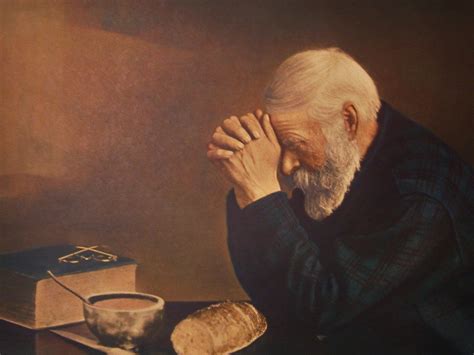
“Devote yourselves to prayer, being watchful and thankful” (Colossians 4:2)

Every year we have the National Day of Prayer. I am glad we have a National Day of Prayer because it makes a statement about our country’s roots. It shows that there is at least enough support left in our country to still have some special “spiritual” days on our federal calendar. I may be in the minority on this as a Christian, but I often wonder if “special days” like this are more symbolic than effective. For example, let’s say for a moment that we have a national day of healthy eating. One day a year the country is bound together by brussel sprouts, salad bars, and tall glasses of ice cold water. It might be a nice statement we are making about good eating habits, but it will do very little for our bodies after that single celebration. If the next day reverts back to pizza and the bottomless french-fry plate, I am not sure we will see anyone from the cover of a Harlequin romance staring back at us from the mirror.

The Colossians verse above does not have an attachment that says “one day a year” preceding the verse. Devoting ourselves to something means to show love, loyalty, or enthusiasm. Devotion seems to indicate an “all the time” activity and not just a “part of the time” activitity. If we only show love for our family members on their birthdays and the rest of the year ignore them, I am not sure they will be that appreciative. It is somewhat like the woman who said to her husband on Sunday morning, “Why don’t we do something different for once. You treat me nice on the way to church, and yell at me once we get there.”

I bet there are a lot people out there who would like to work on Labor Day and take the rest of the year off, but that would be a tough way to make a living. Consequently, I think God would trade our prayerfulness on the National Day of Prayer, for our prayers on the other 364 days of the year.  A “National Day of Prayer” should not be the “Only Day of Prayer” for believers. It is nice to come together on a special day of prayer emphasis, but it will never substitute for a year-long habit of prayer.

I believe it is wonderful to set aside a specific time each day to meet with God. But let’s say that, for whatever reason, it is difficult to find an extended time period to sneak off all alone to read, intercede, or talk to God. First of all, it should not be like brushing our teeth for the full two minutes daily (a tedious venture that often seems like 20 minutes). I will admit, sometimes I stop my toothbrush before the time is up because it just seems to be eating into valuable time. But what would it be like to only brush our teeth once a year because it seems tedious at times.  Prayer should not feel like that kind of task every day, but unfortunately, it can often feel that way.

One of the neatest prayers I ever heard uttered was at a banquet for the Fellowship of Christian Athletes. Bobby Richardson, former New York Yankee second baseman, offered a prayer that is beautiful in its brevity and poignancy: “Dear God, Your will, nothing more, nothing less, nothing else. Amen.” That didn’t take long, but it said it all. It recognized who God is, what He can do, and submits our requests to His will. I think we sometimes think that if we can’t sit down for an hour of prayer, we can’t sit down at all.

The other day I mowed all the lawn at our house.  It went well, but sometimes I don’t start the lawn at all if I can’t get the whole thing finished at one time. That is pretty silly. It is not like a haircut and if the barber stops in the middle it will cause a stir when we leave. But yet, we sometimes think prayer is like that. If we think about starting but can only pray for ten minutes when we have enough prayers for an hour, we decide we shouldn’t start at all. Not starting at all is not the solution. We need to start because nothing is ever done without starting.

We need to prioritize our prayer list just like anything else in our lives. There are certain things we should pray about daily and other things maybe weekly. There are several hundred countries that need prayer everyday, but Operation World and God do not expect us to pray for them all every day. We pick out a couple of countries and bring them before God each day and God listens to our hearts. All prayer is like that. In our own friendship and family circles, we have hundreds of prayers. We need to pray for unbelievers belief and believers strength. We cannot fit them all in daily.

If we have something come to mind while we are praying we can bring it before God. During my prayer time last week I had someone come to my thoughts who hadn’t crossed my mind in months. I prayed for him. Then at our elder’s meeting, his name and situation came up and we were asked to put him in our prayers. I guess God just gave me a heads up a little early. If we need to pray about something, I think it will pass our way and then we need then to act on it.

God has told us ‘If you will call on me and come and pray to me, and I will listen to you.” (Jeremiah 29:12) That is a wonderful promise. We may not be like Praying Hyde who wore the knees out on his pants monthly because he would pray hours a day, every day, but we can give God the respect He deserves by coming before Him often. It takes me 23 minutes to drive out to Camas every day. That does not change unless there is a slow, lumbering truck- behind me honking his horn, and then I speed up. That is 23 minutes I can go to God (I never close my eyes). In that time I can intercede for many. I can always remember my close family and friends and if there are critical prayer needs I can jot them on a paper and clip them to my visor (it is not dangerous, a glance at the paper  takes the same amount of time as glancing at my speedometer- which I do all the time especially when I am approaching 50 mph).  What more important things can we think of on our way to work than prayer? There are none.

I will continue this posting next week, but my thought is this. God would rather we give Him time every day, rather than one day a year. Throughout the day we will get reminders if we open our hearts to it. When I was young everyone around me would remind me to pray. My mom would say, “You better pray that stain comes out,” or at school my friends would say, “You better pray your dad doesn’t find out,” and even my principle would say, “You better pray I won’t decide to tell you parents about this.” Everyone was encouraging me to have a strong prayer life! The truth of the matter is this, we have much to bring before God and we
need to do that wherever and whenever we can.

Psalm 81:10 says, “Open your mouth wide and I will fill it!”  If some of us brushed as little as we pray, it wouldn’t be God saying these words in Psalms, it would be our dentist! Prayer is not a yearly thing; it is a daily thing. Let us pray, every day.

Patience is a Virtue…

Psalm 37:7 “Be still before the Lord and wait patiently for him; fret not yourself over the one who prospers in his way, over the man who carries out evil devices.”

We have all heard the saying, “Give me patience, Lord, and please hurry.” Waiting without worrying is a difficult task for most of us. We tap our feet waiting for God to work and though we ask that His will be done, we also would like His will to be in our time frame. But God has surrounded us with a world that can’t be rushed, as an example of how we should live. Trees grow at their pace, the tides are predictable almost to the minute, the sun rises with the accuracy of a timepiece, and nothing we can do will radically change the processes of nature. God seems to be the great scheduler and the world around us is a constant reminder of that.

In Ecclesiastes 3 we read that “For everything there is an appointed time, and an appropriate time for every activity on earth: A time to be born, and a time to die; a time to plant, and a time to uproot what was planted; A time to kill, and a time to heal; a time to break down, and a time to build up; A time to weep, and a time to laugh; a time to mourn, and a time to dance. A time to throw away stones, and a time to gather stones; a time to embrace, and a time to refrain from embracing; A time to search, and a time to give something up as lost; a time to keep, and a time to throw away; A time to rip, and a time to sew; a time to keep silent, and a time to speak. A time to love, and a time to hate; a time for war, and a time for peace. (Ecclesiastes 3:1-8) God is the great timekeeper. He knows the best times. He has built a world that demands our patience. The farmer should not force the fields, anymore than we should force God to work in our lives before the time is right.

There was once a little girl who tried to help a butterfly out by opening up its cocoon. When the butterfly died, the girl’s father explained that the butterfly actually needed the struggle of leaving the cocoon to prepare it for its life journey ahead. The butterfly died because of the girl’s good intentions. It was not yet strong enough to leave its “womb,” and had been forced into the world too soon. We sometimes wish that God would jump in and give us what we want as soon as we want it. Sadly, that would often leave us unprepared to take on what lies ahead.

I sometimes have students who don’t want to wait long enough to put a second coat of varnish on their projects. They will put the second coat on before the first coat has completely dried. It causes all kinds of problems. Their impatience leads to long sanding sessions and two or three extra coats of varnish. In an attempt to finish things quickly, they actually add two or more days to the project. Of course, they usually only do that once!

We often do the same thing with our lives. We desire the end product before it is ready. My mom used to keep a toothpick with her when she baked. She would open up the stove and stick that toothpick in to check the progress of the cake. She understood the need to wait. If it would have been me, I probably would have been pulling the cake out when it could still be poured! I wanted that cake sooner than it was ready. God keeps a toothpick handy and we don’t. He waits until things are ready, but we won’t.

An old friend of ours, Mildred Bilderback, had a cute saying that she pulled out once in awhile when someone showed impatience. “If we try to fix a fix that God has fixed to fix us, He will have to fix another fix to fix us.” This little tongue-twister has a good message. God knows what lies ahead and wants us to be prepared for it. If we try to shortcut around His path, we will eventually have to get back on His path again and all we will have done is taken the long way around.

Lack of patience can keep us from doing God’s work. Some of the greatest missionaries of history devotedly spread the seed of God’s Word and yet had to wait long periods before seeing the fruit of their efforts. William Carey, for example, labored 7 years before the first Hindu convert was brought to Christ in Burma, and Adoniram Judson toiled 7 years before his faithful preaching was rewarded. In western Africa, it was 14 years before one convert was received into the Christian church. In New Zealand, it took 9 years; and in Tahiti, it was 16 years before the first harvest of souls began. Had these missionaries given up because of impatience, the thousands who eventually came to know Jesus through their ministries may have never become a part of the Body of Christ.

I once heard a story of a mother who was shopping with a crying, demanding three-year-old in the cart. The mother would say, “There are only three more rows, Ellen, and we will be leaving.” The child would demand something else in a loud voice and the mother would softly say, “Only a few more things, Ellen, and we will be checking out.” The girl continued her crying in the checkout line, and the mother said quietly, “We will be in the parking lot in just a minute, Ellen.”

A man happened to hear the whole thing and saw the mother in the parking lot while he was leaving. “I couldn’t help noticing how patient you were with little Ellen in the store,” he said, smiling at the mother.

“Oh, my daughter’s name is Tammy. My name is Ellen.”

Sometimes we need to patiently remind ourselves that the world does not always move at our desired pace. We are told in Thessalonians to “… admonish the idle, encourage the fainthearted, help the weak, be patient with them all.” (1Thessalonians 5:14) God asks us to be patient with people and patient with situations and especially patient with His work in our lives. We can do that if we truly believe that He loves us, He is in control, and He desires the best for us. We live in a world of turmoil around us, it is important that we live lives that have peace within us. We cannot change the world; we can only change ourselves. That power cannot come from us; it can only come from God.

I was sitting at a red light the other day and in front of me was a huge sixteen wheeler and another car. The light turned green, but the truck did not move. The car in front of me started honking (as you know, the only thing faster than the rapture is the honk of the car behind you when the light turns green), and after a few seconds a motorized wheelchair came creeping out from in front of the truck. It was barely moving and apparently did not have time to get across before the light turned. I had to think how foolish the man in front of me felt when the wheelchair finally pulled onto the sidewalk and we started moving. How much are we like that man, though. God can see something that we can’t see and here we are honking our horns of impatience.

“For whatever things were written before were written for our learning, that we through the patience and comfort of the Scriptures might have hope. Now may the God of patience and comfort grant you to be like-minded toward one another, according to Christ Jesus.” (Romans 15:4-5) May the comfort of the Word and the presence of God give us patience today. Like my mom used to say, “You need to trust my toothpick more than your eyes.” Remember God is carrying the toothpick and we will surely reap the rewards- in due time.

« Older posts Newer posts »

© 2026 HE HAS OUR BACKS

Theme by Anders Noren — Up ↑