“Lord, in the morning you will hear me; in the morning I will present my case to you and then wait expectantly for an answer.” Psalm 5:3
 Over the past couple of weeks, I have shared about some of the difficulties I have faced in developing an effective prayer life. I realize now that part of my problem was setting aside the role of the Holy Spirit in my prayers. I tried to take over the process on my own. It is really the work of the Holy Spirit to make my prayers effective, and it is my job to stay out of the way and let Him direct my prayers.
 As Paul tells us, “In the same way, the Spirit helps us in our weakness, for we do not know how we should pray, but the Spirit himself intercedes for us with inexpressible groanings. And he who searches our hearts knows the mind of the Spirit, because the Spirit intercedes on behalf of the saints according to God’s will.” (Romans 8:26-27) I think that too often we become hinderances to our own prayers with our attitudes and approaches. What I have tried to do in recent years is give the Holy Spirit more freedom to direct my prayer life. John tells us in John 14:26 “But the Counselor, the Holy Spirit, whom the Father will send in my name, he will teach you all things, and bring to your memory all that I said to you.” If the Holy Spirit, who is as real as God the Father and Jesus the Son, dwells within us, we should probably allow Him to be teacher He is supposed to be. Our prayer life is not our own, but is by the Spirit, through the Son, to the Father. Although there is only one mediator between God and man, Christ Jesus, our access to Jesus is because of the indwelling Holy Spirit. We can never forget that…yet, we do.

In Galatians Paul explains, “the person who sows to his own flesh will reap corruption from the flesh, but the one who sows to the Spirit will reap eternal life from the Spirit.” (Galatians 6:8) Paul is not only speaking for himself when he tells us in Romans 7:16 “I know that nothing good lives in me, that is, in my flesh. For the desire to do what is good is with me, but there is no ability to do it.” So if there is no ability to do good, what hope do we have? Paul reminds us of our hope in the next chapter when he says, “Those who are in the realm of the flesh cannot please God. You, however, are not in the realm of the flesh but are in the realm of the Spirit, if indeed the Spirit of God lives in you.” (Romans 8:8-9) It is apparent that the Holy Spirit must play the primary role in our prayers if our prayers are going to be in alignment with God.
With all of this in mind, I will tell you how I have tried to revamp my morning and afternoon prayer time. I will start with the morning because it comes first almost every day. In the past I would read the Bible, do some other reading, pray my prayer list, and then do a little writing. Often, I would have to rush so much to get through everything that I was not giving my prayer time the solemnity it deserved. On the other hand, I had so many prayers, that if I did not rush, 
I would not get through them all and those on the end of my list were left out in cold. The problem was me. I was trying to do everything on my own by using a checklist of tasks. I was sacrificing a true prayer to “get things done.” I am hopeful that God looked beyond my overly-structured approach to prayer and extended undeserved grace by answering some of my prayers. I know there were answers, I am just not sure how much I had to do with it.
So I knew I had do something different. Getting up early had never been a problem for me, it was using the time wisely that I had to address. I have always had a special quiet place to pray, so that was not an issue either. So if I had the time and had the place, why wasn’t I getting a handle on these morning prayer times? I needed to check my heart. I knew I did not want to be ritualistic, but I did believe I needed to be disciplined. What was the solution?
 I have always been a reader and began reading every prayer book I could get my hands on. I read biographies about George Muller, Praying Hyde, Taylor Hudson and other great pray-ers. I also read books such as The Kneeling Christian, The Hour That Changes the World, the Common Book of Prayer and studied authors like Andrew Murray and Leonard Ravenhill. I even subscribed to prayer podcasts. I got good ideas from all of them, but there was still something missing. Then something I heard in a sermon that set me on another course. I realized that I was trying to do all the work on my own. I had the One within me that moved upon the waters at
  creation, and I was trying to this on my own. The sermon I listened to was on the Holy Spirit. The Holy Spirit tends to be the neglected person of the trinity. There are over 600 prayers in the Bible and over 400 known answers to prayer. The Holy Spirit played an instrumental part of those prayers, yet for every mention of God the Father and Christ the Son in the church today, the Holy Spirit falls into a sad third place. Consequently, I realized the the Holy Spirit was playing a sad third place in my life, as well.
I started to think that ignoring the power of the Holy Spirit in my life might have something to do with my inconsistent prayer life. I started to make a connection between the reoccurring problems in my own and other’s prayer lives and my own and maybe others disconnect from the Holy Spirit. I talked to many people about prayer and one of the things seems to always come up was the “wandering mind” problem. Struggling to keep focused during prayer seemed to be somewhat universal. I began praying aloud many years ago to combat those roving thoughts, but that only got me part way there. I found out, after hearing the sermon, that it is better to allow the Holy Spirit to direct my wandering mind. In other words, let my mind wander under the direction of the Spirit’s leading. It is a wonderful thing. It takes my prayers out of my head and puts in the hands of the Holy Spirit- where they need to be. What is amazing is my mind no longer wanders to unrelated things, but to other prayer needs. Instead of wasted thoughts, they are useful thoughts.
The way I involve the Holy Spirit is by Praying the Bible. This method has been around for a long time, but I don’t think I understood it. Although, I still keep a list, but I don’t use that list in the morning except for our kids and grandkids and immediate needs. Instead I pick a section of scripture (the Psalms are perfect for this) and pray that God will give me wisdom as I read it all the way through. I ask God to bring things to my mind that I need to be brought to my mind. I will then read the scripture again one phrase at a time, and I allow each phrase to take me somewhere. Often that phrase might lead to a multitude of people or situations, and I just let it go there. What is amazing is  that each part of the scripture will lead to new needs. Sometimes the prayers I pray might not match up with the deeper meanings of the scripture, but will still remind me of a certain person or need. My mind does not take off on useless adventures, but actual prayer paths. Instead of being lost in thought, I stay focused.
Let’s see how this works. Psalm 1:1 says “How blessed is the one who does not follow the advice of the wicked, or stand in the pathway with sinners, or sit in the assembly of scoffers!” I will say one part of the verse aloud and without me thinking about it, prayers will come to my mind. After reading the first sentence of the verse above, I might think of someone who is caught up in something wicked, or maybe someone who is fighting against wickedness in his own life, or leading the the fight against wickedness. The whole planned parenthood disgrace might be brought to mind. I might think of someone who is leading people into something wicked. I might even think of something like the terrorists that are plaguing the world right now. Often that prayer will lead to remembering someone or something else.  Sometimes that one line will lead to five or six requests that actually may or may not be on my prayer list. If I have studied the prayers on my list at all, it will not take much prompting from the Holy Spirit to bring them to mind. On the other hand, there may be things I have not even thought of before that might be brought to mind. I used to do the same thing in the past, but it was not requests that were brought to mind, but thoughts of things that directed me away from prayer. This is much different. With this method there is an endless supply of readings to stimulate daily prayer. There are enough Psalms (some longs ones can be divided into several days) for well over a year of prayer, and we can use many other books of the Bible, as well.
What this does is allows the Holy Spirit to prompt my prayers rather than having to constantly be consulting a list. Sometimes I don’t pray as long when I Pray the Bible (often with the list it was well over an hour), but I believe the prayers are more natural, more sincere, and more in line with God’s will. I read the Word, thank God for it, and then use those same verses to bring needs to mind. If ten of us were reading the same verses, we would probably have ten much different prayers that we would be uttering. The unrestrained direction of the prayer allows the Holy Spirit to be a participant rather than a spectator. It takes the pressure off me and reminds me that God has left a comforter with me. I am comforted by His presence and instruction.
I believe this kind of prayer emphasizes quality over quantity. I used to believe if I did not complete a long list of names, accompanied by several countries, and some worthy causes, my prayer time was a failure. I now believe that Satan enjoyed the guilt I felt because I would sometimes allow these negative feelings to be an obstacle to prayer.
 Praying through the Bible is a wonderful tool that puts the Word and Holy Spirit in charge of my prayer time. It is a wonderful thing to feel my mind wander with purpose. I don’t think Satan is pleased with a mind that “wanders purposely” and anything he hates I love. Praying through the Bible takes care of my morning devotion and prayer time, but what about my lists that I keep? Do I just disregard them? Not at all. Next week I will share what I do with the prayers found on my prayer request list. Until tomorrow remember, “Do not be anxious about anything, but in every situation, by prayer and petition, with thanksgiving, present your requests to God. And the peace of God, which transcends all understanding, will guard your hearts and your minds in Christ Jesus.” (Philippians 4:6-7)
Have a blessed day!
 but our decision is contrary to the Word, we can be assured that it is not God’s will. But it is not that easy! What about things that are not spelled out for us. What if we are trying to decide what job to take, which house to buy, or even where to put our money, can we really find places in the Bible that can help us?
 God in Christ Jesus concerning you.”
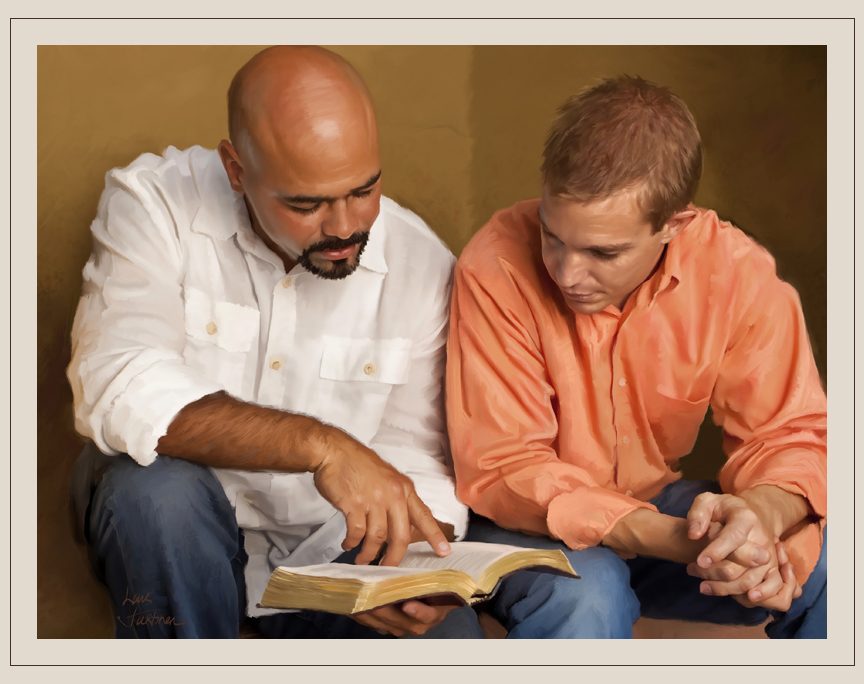 “Comfort the feebleminded…” We should comfort people who are disheartened, disoriented or confused. We should come alongside them with brotherly affection, encouraging words, and prayer.
 in this world to corrupt our own behavior and character. This is a constant temptation throughout life because evil people are everywhere, including the church. It is easy for us to compromise our own faith because others do it. We need to stay strong in light of worldly influences.
 “Pray without ceasing…” Some of us might find the idea of praying constantly just a pipe dream. The Lord, however, is wide open to communication with Him 24/7, why not continually include Him in your words and thoughts? He should never be far from our minds and we should continuously look for reasons to speak to Him.
 that these kinds of statements are all throughout the Bible. Just obeying these exhortations in these verses can give us direction in many, many decisions. Wherever the Lord calls us, He calls us to live out these things. God’s Holy Spirit inspired these words, and He alone gives us the power to carry them out. Our part is to believe and act, and He then will direct our paths.



 I once heard a wise saying that brings the perspective of distractions into focus for me. “Whatever is not your assignment is your distraction.” I used to talk to my athletes a lot about this, especially on game day. I would say that during the game your assignment must be primary. If the guy across the line gets you thinking about him and the way he is holding you on every play or starts talking about your mother or even tells midget jokes about your head coach, you cannot let your mind go to those things. They are merely distractions that interfere with your assignment.
 diverts, or entertains. Wow, is that almost our entire world! Television, radio, video games, smart phones, sports, hobbies, are all available at a moments notice, and these are only a few of the hundreds of activities that are ready and willing to take up our time. How do we discern between distractions of the world and assignments of God? How do we stay on task in a world that provides so many play things.
 One of the devil’s greatest weapons against Christians is our own ignorance. If he can deceive us, he can beat us. But do we allow our distractions to keep us from the assignment of knowing God? The Apostle Paul said, “I am saying this so that no one will deceive you with persuasive arguments.” (Colossians 2:4) If we put all our energy into things that don’t strengthen our spiritual lives, we will remain ignorant and thus vulnerable. God warns us in Hosea that, “My people perish for a lack of understanding.” (Hosea 4:6) So to keep from being deceived and to keep from perishing, we need to know God better. To know God better, we cannot be live in a state of distraction from Him.
 serving… well, you know the drill. If we were to draw a line in the sand and wrote all our time commitments that do not include God on one side and wrote down all the things that increase our spiritual understanding on the other, what would those lists look like? No matter how spiritual we are, the spiritual list will be shorter. We all have jobs, some of us have children, some of us have wonderful hobbies and all of us have a multitude of activities. It is not whether the spiritual list is shorter, it is whether it exists at all.
 church 24-7 and knowing that there are many activities in our life, we must be careful that we do not involve ourselves in the world to the detriment of the things of God. Paul says in Romans, “I want you to be wise in what is good, and simple concerning evil. And the God of peace will crush Satan under your feet.” (Romans 16:19-20). If we don’t allow distractions to keep us from knowing God, Satan will be crushed by God. If we allow distractions to keep us from knowing God, it is us vs Satan and we are sorely overmatched.
 God told us in Philippians 4:8 when he said, “Finally brothers, whatever is true, whatever is honorable, whatever is just, whatever is pure, whatever is lovely, whatever is commendable–if there is any moral excellence and if there is any praise–dwell on these things.” If our distractions don’t include these things, we may want to find some other distractions to be involved in. If they do, that probably means that we have Christ where he should be in our lives- at the center.








 I have another one hundred or so from our church, fifty from work, and multitudes of others from vagrants to presidents. Actually, when we look around us, there is probably no one that does not need prayer- so mine is a short list.
 multitudes of requests and the ability to find time to discuss those requests with God. I wanted a Spirit-filled prayer time that allowed me to intercede for others. There had to be a way!
 logically as well. If God tells us that He is sovereign and if He also tells us we have free will, both of those must be true. So even though God is in control, He is still moved by our prayers. How can the mighty immoveable God of the universe be moved by the prayers of puny man? I don’t know how God reconciles these seemingly contradictory statements, but I know He does. God would not call us to do something that was meaningless, so His call for our prayers must have meaning.
 that next week when I talk about something that has radically changed many people’s prayer lives. Today’s emphasis is this: we need to believe prayer is important or we won’t find it important to pray.